
How to Specify an Emergency LED Light Bar for a Fleet
By UNIT SIGNAL ·
Specify an emergency LED light bar by vehicle group, warning task, mounting envelope and control requirements. Put those four items in the RFQ before listing candidate lengths. The result should let two suppliers quote the same configuration and let the upfitter check it against a real vehicle. “48-inch LED light bar with amber flash” is a useful search term, but it leaves the mounting kit, usable warning modes, harness and acceptance criteria open.
Build the specification around vehicle groups
Group vehicles by the details that affect fit or operation, including roof construction, body height, upfit equipment, power system and operator controls. Two trucks with the same badge can need separate configurations when one carries an overhead rack and the other has a service body. Conversely, two different models can share a configuration if their mounting and electrical requirements genuinely match. Have the upfitter identify a representative vehicle for each group and note any known exceptions.
Describe the work in plain language. A recovery team securing a roadside scene may need conspicuity from defined approaches and a separate work-light function. A supervisor vehicle may need a simpler warning package but face a tighter clearance limit. List when and where the warning signal is used, which directions need coverage, and which other lights already serve those directions. Specify a function only where it solves a task. That gives suppliers room to offer equivalent equipment without deciding the fleet’s operating policy for you.
| Decision | What the buyer records |
|---|---|
| Vehicle group | Body configuration, mounting surface, existing roof equipment and estimated quantity. |
| Warning task | Intended use, required viewing directions, destination and other lights in the package. |
| Physical fit | Mount locations, usable footprint, installed height limit and connector clearance. |
| Operation | Required warning functions, planned controls, vehicle supply and service access. |
Give the supplier an installed envelope
Take top and side photos with the equipment the vehicle will carry. Mark where the bar can sit, where mounting loads can be transferred and where a cable can reach the interior without fouling moving parts. Include an antenna, rack, hatch or roof accessory even when it sits outside the bar’s footprint if it could block light or prevent maintenance. Ask the upfitter to identify vehicle manufacturer mounting restrictions before settling on the installation points.
Use a stated datum for height. A limit measured up from the roof panel is different from a limit for the vehicle as a whole at a garage door. Measure the complete installation with the selected brackets and any support foot. Allow enough room to remove covers and reach connectors. If the fleet uses multiple building entrances, record the lowest relevant clearance rather than the clearance of the bay used for the trial.
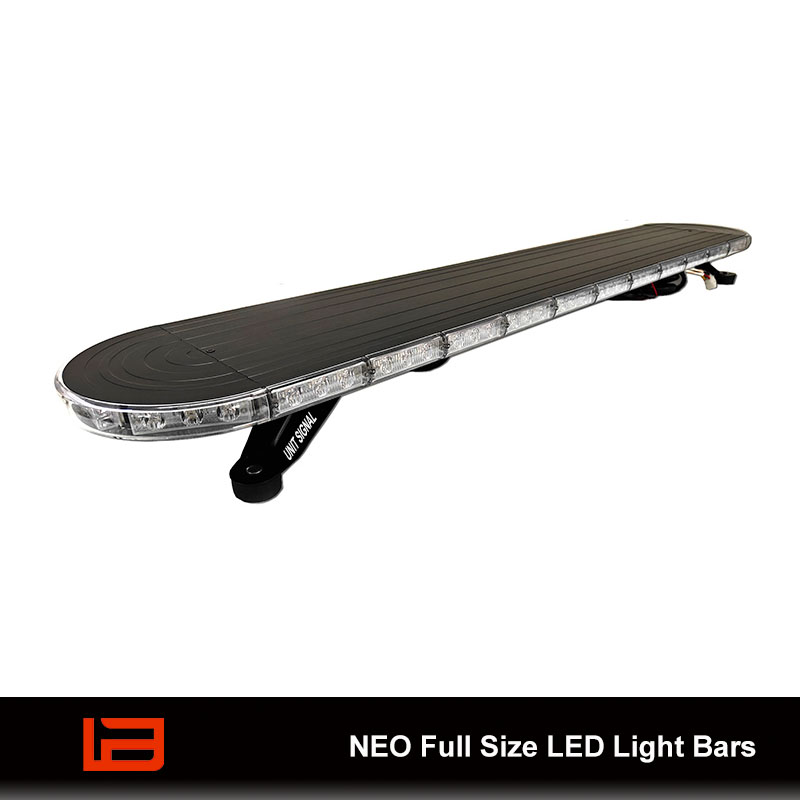
The NEO full-size LED light bar illustrates why this matters. Its page describes the housing profile separately from its bracket-inclusive dimensions and lists multiple lengths. Use the drawing for the quoted variant and mounting kit to check the actual envelope. A nominal size can help narrow the range, but a bracket-inclusive drawing is a better purchasing reference. For another way to record the measurements, see the light bar sizes and measurements guide.
Define the signals the operator must be able to select
Write a short list of operating states with a purpose for each one. Separate the main warning function from any directional indication, work illumination, alley or takedown lighting. If a function is optional, ask suppliers to price it separately so quotes remain comparable. If two functions must be available together, write down the allowed combination. A list of flash patterns does not establish which colors, modules or outputs can operate at the same time.
Record any color and warning-mode constraints supplied by the fleet for the vehicle type and destination. Keep those constraints separate from the color options offered by the supplier. Where a document is required for an approval review, ask the buyer’s vehicle or compliance lead to identify the applicable requirement and the configuration it covers. The supplier can then identify relevant records for the exact version instead of sending a broad description of the product family.
Specify the power and control interfaces
Record the nominal vehicle voltage and the supply conditions at the proposed connection point. Request the operating supply range and current data for the quoted configuration, including combinations the driver is expected to select. An LED component wattage, a catalog maximum and the actual current drawn by an operating mode are different figures. Have the upfitter use the model instructions and the vehicle’s electrical requirements when designing protection, wire routes and connection points.
Ask whether the quote includes a standalone controller, a hardwired interface or a specific control accessory. Specify the cable length between the roof and driver position, including routing around trim and any service loop the installer requires. Give the name and revision of any existing control system that the new bar must work with. If the fleet needs synchronized outputs or a specific behavior after ignition cycling, put those tests in the RFQ. A connector that physically fits provides no assurance that the signals or operating logic match.
Split mandatory requirements from acceptable alternatives
A specification is easier to quote when a supplier can see which conditions are fixed. For example, installed height may be a hard limit, but two mounting kits could be acceptable if each uses approved attachment points and meets that limit. Instead of requiring one bracket shape without a fit reason, describe the clearance, allowable attachment locations and drawing the buyer expects. Compare only alternatives that meet the fixed conditions.
Keep commercial assumptions with the quote. Ask what an alternative package would change in the bill of materials, install time and future spares. Where the vehicle group is still being finalized, request prices by configuration and record the quantities the supplier used for comparison. Have the final purchase order identify the selected options explicitly so it does not inherit assumptions from a trial unit.
For procurement across depots, give all installers the same drawing revision and keep an exception record. If a depot cannot reproduce the approved cable route or attachment points, record how its vehicle differs and agree the solution before the bar is installed. This gives the buyer a practical way to manage variations without writing a completely new specification for every individual vehicle.
Compare supplier responses on the same basis
A useful response includes one identifiable bar configuration per vehicle group. Ask for the length, lens or color package, brackets, harness, controller and document revision in the offer. Separate required items from optional features and list anything the upfitter must provide. This keeps a quote for a complete kit comparable with another quote that prices the mounting and controls as additional items.
Request model-level evidence where it affects acceptance. Depending on the job, that can include a mounting drawing, wiring diagram, description of the enabled functions, ingress test documentation, or optical records identifying the configuration and test conditions. Compare optical results only when the measurement conditions and configuration are comparable. Identify whether a record describes the actual quoted unit, another length in the same family or a different operating mode. Request clarification if the relationship is unclear.
Use the first installation to close the open decisions
Approve a sample on a representative vehicle before repeating the installation across a fleet. Check the physical envelope, then observe the intended approaches in a controlled area with equipment in its normal working positions. Have the operator run the required states from the driving position and record whether indicators, labels and restart behavior are understandable. Confirm the installer can reach fuses, connectors and mounting hardware for service.
Retain the part numbers, drawing revisions, configuration and labeled photos of the accepted installation. If a proposed substitution changes bracket geometry, module layout or controller behavior, review the affected checks before treating it as equivalent. A purchase order should refer to the approved configuration or document set, especially when different depots will install or service the same equipment later.
Questions buyers ask before sending the RFQ
Can one RFQ cover several vehicle types?
Yes. Use a separate line for each fit or control requirement, with its own vehicle description, quantity and drawing reference. List shared requirements once. Ask the supplier to point out where the same bar or harness can be used without changing the accepted installation.
Which documents are most useful early in the project?
A dimensioned drawing with the proposed bracket and an interface or wiring diagram usually resolve initial fit questions. Request model-level performance or approval documents once the proposed color, length, mode and mount are clear enough to determine whether the document applies.
Send a fleet light bar RFQ
Include vehicle groups and quantities, destination, roof photos and dimensions, maximum installed height, required signals, supply details and controller requirements. Say whether you need a sample, a spares list or shipping information in the quote. Start with the full-size and mini LED light bar range, then send UNIT SIGNAL your fleet light bar specification so the discussion can focus on a specific model and configuration.